Use the below links to display a list of men by surname that appears on the War Memorial.
| A | B | C | D | E | F | G | H | I | J | K | L | M | N | O | P | Q | R | S | T | U | V | W | X | Y | Z |
Or by date of death (will not display all names).
| 1914 | 1915 | 1916 | 1917 | 1918 | 1919 | 1920 | 1921 | 1922 | 1923 |
Hamilton Maxwell Fleming
04/03/1876 - 23/04/1915
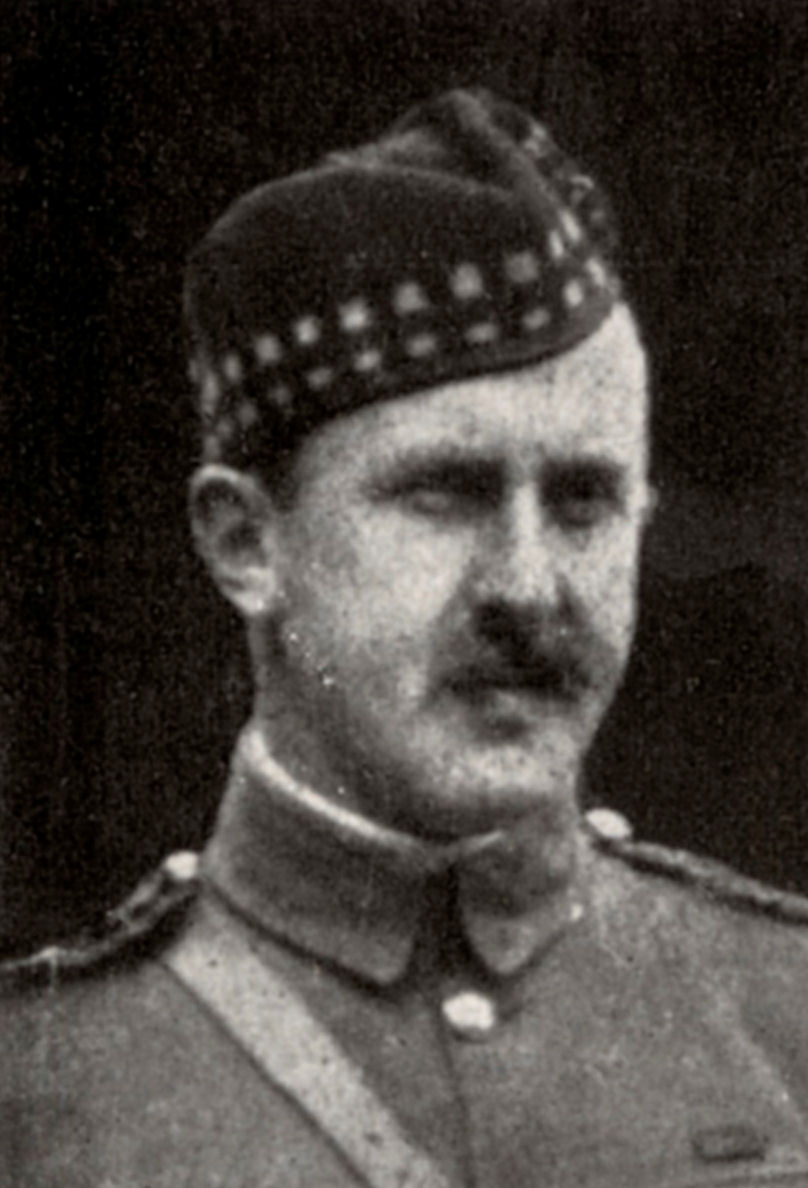
Source: Dulwich College
Other Memorials: St Mary's Church, Shortlands, Shortlands War Memorial, Beckenham War Memorial, Dulwich College
Place of birth: Sidcup, Kent
Last known address in Bromley: Tower House 23 Toots Wood Road
Last known address in Bromley: Tower House 23 Toots Wood Road
Military information
Regiment/Service: Canadian InfantryBattalion/Ship: 16th Bn
Rank: Captain
Number: Unknown
Family information
Parents: John & Mary Fleming (nee Buchanan)Parents' occupation: East India merchant
Siblings: Mary Buchanan (d), Agnes Isobel, Alice Clara, Beatrice Helen, William Nichol, John Arthur (d), Norman Robert, Malcolm Buchanan, Edward Graham, Herbert James, John Kenneth Sprot, Margaret Elizabeth
Census information
1891Address: Wych Elm, College Road, Camberwell
1901
Address: South Africa
Occupation: Army
1911
Address: Vancouver
Extra details
Hamilton (known as Toby) was the 12th of John and Mary Isobel Fleming's 13 children. Their seven surviving sons attended Dulwich College where they all distinguished themselves. Hamilton was at Dulwich from 1889 to 1895 where he was :-
Vice President of the debating society 1893-4.
Editor "Alleynian" 1894-5.
Member of the Rugby First XV in 1894-5, and in the Cricket 2nd XI in1895.
He was a Lieutenant in the Corps, and at Aldershot in the Public Schools Competition won the medal for fencing in 1895.
Soon after leaving School he presented a challenge bowl for fencing which bears his name.
He was ranching in the Argentine at the time of the South African War and worked his way to Cape Town on a cattle boat to enlist. He joined the 2nd Brabant's Horse in 1900 eventually becoming Regimental Quarter-Master Sergeant but was invalided out of the service with rheumatic fever after about a year's service. For his services he received the Queen's medal with three clasps.
The next ten years he spent farming in Cape Colony and during that time he made three trips across the Kalahari Desert with mules, thus seeing something of the German war with the Hereros (1904-7). He also saw a little of the Russo-Japanese war (1904-5) as newspaper correspondent.
In 1910 he went to Vancouver and was one of the first to join the Militia Battalion of the Seaforths raised in that town, in which he commanded "A" Company.
At the outbreak of war he volunteered at once and came over with the 1st Canadian Division, commanding a company of the 16th Canadian Scottish. After training at Salisbury they were sent over to France in February, 1915. They went into the line in the Ypres salient and during a counter-attack on "Kitchener's Wood ", while leading his company, he was shot through the leg . One of the men who was with him wrote: "I tied up his leg and wanted him to go back to the dressing station, but he was too good an officer and too brave a gentleman to do that, as he thought the boys needed him."
He struggled on, and shortly after was shot through the head, dying instantly. His body was not recovered.
Thank you to Dulwich College for their assistance.
Additional photographs
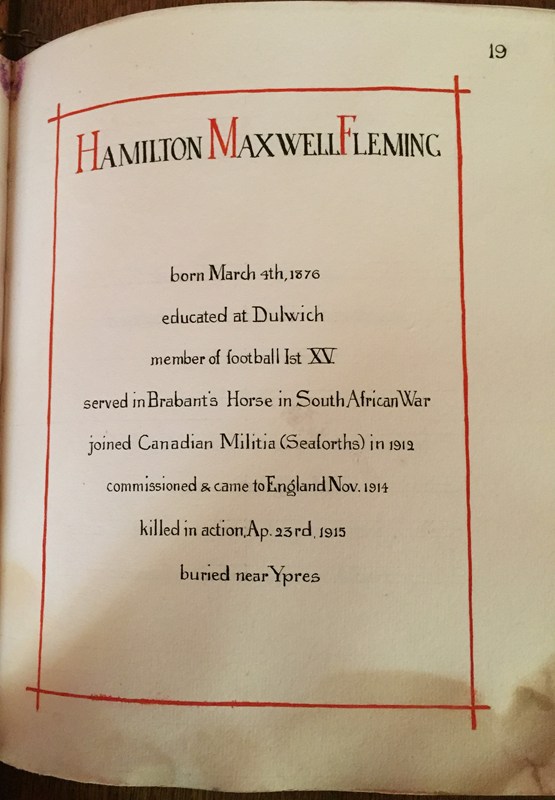
Source: St Mary's Shortlands Book of Remembrance
Is there information missing here? If you can help, please email contact@bromleywarmemorial.org.uk.